Professional LCA Consulting – Independent Quality Assurance for Life Cycle Assessments, EPDs & Carbon Footprints
Why Quality Assurance in Life Cycle Assessment Matters
Independent verification and critical review of your LCA/EPD/PCF (related data) creates benefits across the entire value chain.
- ✓Legal & reputational risk mitigation against greenwashing accusations
- ✓Operational efficiency gains through hotspot discovery
- ✓Market access & competitive edge in procurement processes
- ✓Investment security through improved ESG ratings

- ✓Reliable Scope 3 data for accurate emissions reporting
- ✓Risk transfer through independent verification and critical review
- ✓Simplified purchasing decisions with comparable data
- ✓Brand protection through credible sustainability claims

Where Quality Assurance Applies to Your LCA Study
QA affects every element of an LCA/EPD/PCF – click to explore each part below.
GOAL QA ensures that goal definition is consistently reflected and coherently aligned with your study's objectives.
- Reasons for performing the life cycle assessment/EPD/PCF
- Intended application of the results
- Target groups/audiences (B2B, B2C)
- Supporting comparative assertions intended to be disclosed to the public?
- Compliance with the requirements of the applicable standard/guidelines
INPUT
Ensure inputs meet the required level of accuracy, precision, and representativeness.
Foreground Data
Primary Data
Collected from your own processes, facilities, and operations.
Secondary Data
Data from industry averages, estimates, or literature for foreground processes.
Background Data
Primary Data
Supplier-specific data for upstream and downstream processes.
Secondary Data
Generic LCA database inventories (ecoinvent, Sphera MLC, CarbonMinds, etc.) for background processes.
SCOPE
Verify methodological choices align and comply with standards and study objectives.
Product Systems to be Studied
Identification of the product system(s), their function(s), and life cycle stages (cradle-to-gate, etc.).
Functional / Declared Unit
Quantified reference to which all inputs and outputs are related.
System Boundaries
Specification of included/excluded unit processes and upstream/downstream boundaries.
Allocation Rules
How to handle multi-functional processes, co-products, and end-of-life allocation.
Data Quality Requirements
Specification of Minimum Data Quality and Completeness Requirements of the Study.
Data Requirements
Temporal, geographical, and technological representativeness criteria for data selection.
Impact Assessment Methodology
Choice of LCIA method (ReCiPe, CML, EF 3.0, etc.) and impact categories.
Cut-off Criteria
Thresholds for excluding minor material or energy flows based on mass, energy, or environmental significance.
Assumptions
Documented assumptions about processes, data gaps, and methodological choices.
OUTPUT
Confirm results are transparently described, reproducible, and meet the study goals.
Documentation
Completeness of all required report chapters, structure, formats, and result indicators as demanded by the applicable standards.
Results
Presentation and plausibility of LCA/EPD/PCF results and calculated environmental indicators.
Sensitivity / Scenario / Uncertainty Analysis
Systematic evaluation of how variations in data, assumptions, and methodological choices affect results.
Data Quality Assessment
Evaluation of data reliability, completeness, and representativeness as required by the applicable standards.
Limitations
Clear statement of study boundaries, data gaps, methodological constraints, and applicability of study results.
Conclusions & Recommendations
Key findings and recommendations aligned with the defined goal and scope.
Quality Assurance in Practice
Our consulting services tailored to your needs
Critical Review
Independent evaluation of your LCA or PCF study methodology. We ensure scientific validity, transparency, and compliance with ISO 14040/44, 14067, and 14071—essential for public claims and comparative assertions.
Verification & Validation
Third-party verification that your PCF values and environmental data are accurate, reliable, and compliant. Required for TfS, Catena-X, EPD publication, and B2B data exchange.
Technical QA
End-to-end audit of your data collection, LCA models, and EPD tools. We validate inputs, check model architecture, and ensure physical consistency before calculation or tool rollout.
Industries We Serve
Specialized expertise across key sustainability-focused sectors
Ensuring carbon data credibility across your supply chain:
- •Product Carbon Footprints (PCF)
- •TfS Level 3 Verification
- •Supply Chain LCA Quality
Your path to market-ready Environmental Product Declarations:
- •EPD Creation & Verification
- •EN 15804 Compliance
- •Background Report Review
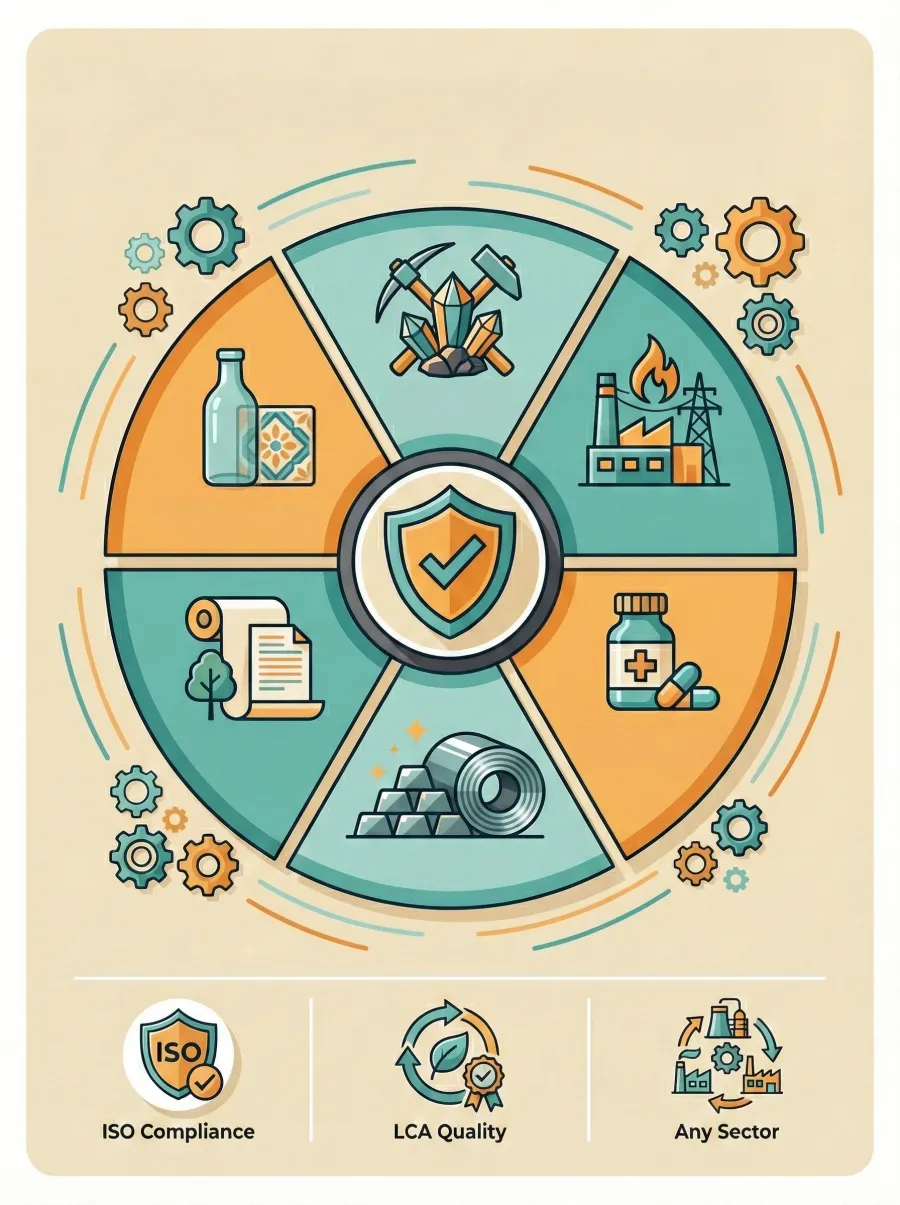
Metals, paper, glass, ceramics—and any sector seeking ISO-compliant LCA quality assurance.
- •ISO 14040/44 Compliance
- •Critical Review
- •Data Quality Assurance
Built on Deep LCA Expertise
Independent quality assurance grounded in nearly two decades of hands-on experience
QuaLCA was founded by Yannick Bernard, a Business Chemistry graduate who spent over a decade at Sphera (formerly thinkstep), rising to Internal Quality Assurance Authority. Apart from being an Approved Individual Verifier of the International EPD System and EPD Hub, QuaLCA offers independent critical review, verification, and technical QA for further LCA-related studies and carbon footprints—ensuring your environmental data is credible, compliant, and defensible.
Ready to Strengthen Your LCA?
Get independent quality assurance from an experienced LCA specialist. Free initial consultation to discuss your project needs.
Get in Touch